Introduction to Scala 3's Capture Checking and Separation Checking
One of the trickiest parts of writing large-scale software is dealing with mutable data. For instance, data might be mutated in unexpected places, or resources might be used at the wrong timing.
Languages like Rust mitigate these problems through ownership and lifetimes. But how do we bring these ideas into a GC-based language like Scala in a way that doesn’t break existing programs? In other words, we want to track access rights (capabilities) to resources (objects in the object-capability model), while leaving memory management to the GC.
Scala 3’s answer is Capture Checking + Separation Checking.
Capture Checking
What is a “Capture”?
Before explaining Capture Checking, let’s start with what “capture” means.
This refers to closure capture. In the following program, the closure increment references c, which is defined outside the closure. We say that increment captures c.
//> using scala 3.8.3
class Counter:
  def inc(): Counter = ???

@main def main() =
  val c: Counter = new Counter
  val increment = () => {
    c.inc()
  }
  increment()
Capturing Types
Capture Checking introduces Capturing Types to track variable captures at the type level.
T^{x_1, ..., x_n}
T: the shape type — a value of this type captures the values in the following capture set{x_1, ... x_n}: the capture set — the set of values this value is allowed to capture
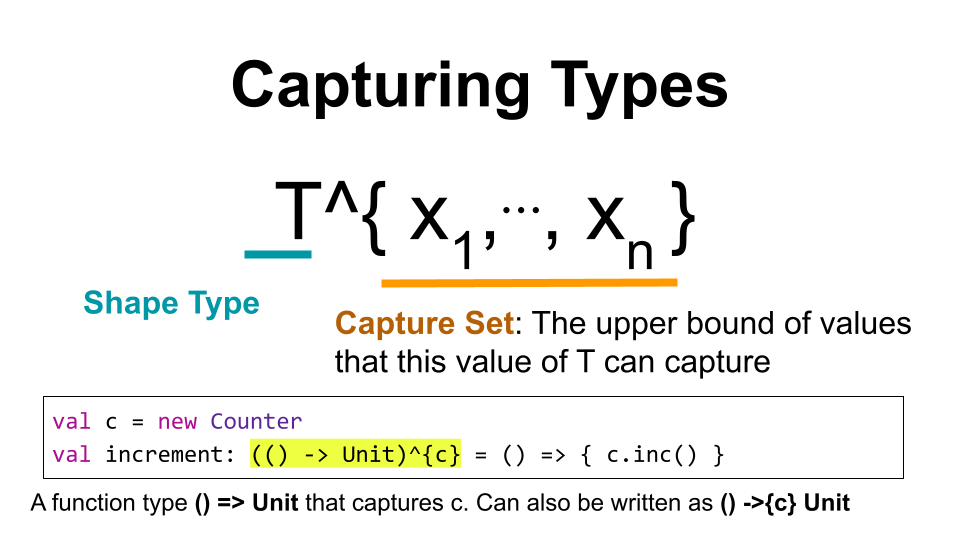
For example, in the code above, increment has the following capturing type.
//> using scala 3.8.3
import language.experimental.captureChecking
class Counter:
  def inc(): Counter = ???

@main def main() =
  val c: Counter^ = new Counter
  val increment: (() -> Unit)^{c} = () => {
    c.inc()
  }
  increment()
Counter^ roughly means “c is a value tracked by capture checking.” 1
And, you might wonder why () -> Unit instead of () => Unit. The -> notation was introduced with capture checking.
- The traditional function type
A => Brepresents a function that may capture arbitrary values. - While the new
A -> Brepresents a pure function that captures nothing. A ->{c,d} Bis shorthand for(A -> B)^{c,d}, which means the function capturescandd.
See Function Types | Capture Checking for details.
What Does Capture Checking Check?
Capture Checking verifies that closures only capture values within their declared capture set. For example, the following program produces an error.
The capture set of increment is ^{c1}, but the closure body also captures c2, which is not in the set: 2
//> using scala 3.8.3
import language.experimental.captureChecking
// ...
@main def main() =
  val c1: Counter^ = new Counter
  val c2: Counter^ = new Counter
  val increment: (() -> Unit)^{c1} = () => {
    c1.inc()
    c2.inc() // (c2: Counter^) cannot be referenced here
  }
[error] ./cc.scala:9:38
[error] Found:    () ->{c1, c2} Unit
[error] Required: () ->{c1} Unit
[error]
[error] Note that capability `c2` cannot flow into capture set {c1}.
This lets us express the constraint that increment can only operate on c1 at the type level. Seen this way, the capture set (^{c1}) can be thought of as the set of capabilities that the closure is allowed to access.
Example: Referentially Transparent Closures
As a simple use case, let’s implement a map that guarantees referential transparency — we want to ensure that the function passed to map doesn’t perform any destructive mutations.
//> using scala 3.8.3
import language.experimental.captureChecking

enum MyList[+A]:
  case Nil
  case Cons(head: A, tail: MyList[A])
  // A ->{} B is shorthand for (A -> B)^{}, a function that captures nothing
  def map[B](f: A ->{} B): MyList[B] = this match
    case Nil => Nil
    case Cons(h, t) => Cons(f(h), t.map(f))

@main def main() =
  var foo: Integer^ = 0
  MyList.Cons(1, MyList.Nil).map { x =>
    foo = foo + x // Error: foo is not in f's capture set
    x
  }
This prevents the function passed to map from accessing external mutable state.
Other Examples
The reference documentation includes several more use cases. By treating values tracked by capture checking as capabilities, you can do things like effect tracking:
Alias Tracking
You might wonder whether aliases confuse capture checking, but they are tracked as well:
val c: Counter^ = new Counter
val a: Counter^{c} = c // the type tells us that a has access to c
val increment: (() -> Unit)^{c} = () => {
  a.inc()
}
Separation Checking
Capture Checking is an experimental feature that is getting closer to be stablized. Separation Checking, on the other hand, is another experimental feature based on Capture Checking.
Capture Checking only tracks whether a value can be accessed. Separation Checking introduces SharedCapability (read-only) and ExclusiveCapability (writable) to track which parts of the program can mutate data. This helps prevent data races in concurrent programs and enables separate tracking of read-only vs. writable effects.
Mutable extends ExclusiveCapability
Separation Checking provides caps.Mutable. Classes that extend it can define methods with the update modifier. An update def indicates that the method mutates the class’s state (or external resources, whatever), and these methods cannot be called in a read-only context.
//> using scala 3.8.3
import scala.language.experimental.captureChecking
import scala.language.experimental.separationChecking

class Ref(init: Int) extends caps.Mutable:
  private var current = init
  def get: Int = current
  update def set(x: Int): Unit = {
    current = x
  }
Here, any (caps.any) is a top capability, essentially the same as the universal capability (cap) from capture checking, but in separation checking each occurrence of any is treated as distinct and exclusive. 4 any.rd is the read-only version of any: it grants read access but prohibits mutation (i.e. calling update methods).
When writing parameter types, Ref expands to Ref^{any.rd}(read-only access). Ref^ expands to Ref^{any} (full access including mutation).
// Ref = Ref^{any.rd}: read-only access
def read(r: Ref): Int =
  r.get

// Ref^ = Ref^{any}: full access including mutation
def update(r: Ref^, value: Int): Unit =
  r.set(value)

@main def main() =
  val r = Ref(0)
  update(r, 4)
  println(read(r)) // 4
Calling an update method inside read is not allowed:
def read(r: Ref^{any.rd}): Int =
  // Cannot call update method set of r since its capture set {r} is read-only
  r.set(0)
  r.get
The Separation Check
Consider a par function that executes two functions in parallel. If one argument calls an update method on a resource, the other argument must not access that resource:
def par[A, B](f: () => A, g: () => B): (A, B) = ???
@main def main() =
  val r = Ref(0)
  // Separation failure
  par(() => r.set(2), () => r.set(3))
  par(() => r.get, () => r.set(3))
  par(() => r.set(2), () => r.get)
  // This is OK — both are read-only
  par(() => r.get, () => r.get)
This constraint might seem overly strict. For a seq function that runs functions sequentially, such restrictions shouldn’t be necessary. This is handled through a mechanism called Hide, which I’ll explain next.
def seq(f: () => Unit, g: () => Unit): Unit = { f(); g() }
@main def main() =
  val r = Ref(0)
  // Separation failure: argument of type  () ->{r} Unit
  // to method seq: (f: () => Unit, g: () => Unit): Unit
  // corresponds to capture-polymorphic formal parameter f of type  () => Unit
  // and hides capabilities  {r}.
  seq(() => r.set(1), () => r.set(2))
Move Semantics
In Separation Checking, T^ (T^{any}) represents a special type: an independent capability shared with no one.
Assigning a variable y to T^ means that y is hidden by the exclusive capability x. As long as x is alive, the original y cannot be accessed (otherwise x and y would share the same capability).
This prevents unintended mutation through aliased references:
@main def main() =
  val y = Ref(0)
  update(y, 4) // ok

  locally {
    val x: Ref^ = y // y is hidden by x
    // Separation failure: Illegal access to {y}  which is hidden by the previous definitio
    // of value x with type Ref^
    update(y, 4) // Error
  }

  // With an explicit capture set, hiding does not occur
  locally {
    val x: Ref^{y} = y
    update(y, 4) // OK
  }
Recall the par definition — its arguments also have the top capability (any): 5
// () => A is shorthand for (() -> A)^{any}
def par[A, B](f: () => A, g: () => B): (A, B) = ???
- When calling
par(() => r.set(1), () => r.set(2)):() => r.set(1)is hidden byf(transitively,rcaptured by this closure is also hidden byf)() => r.set(2)tries to accessr, but it’s hidden byf— so this fails
This can be resolved by explicitly granting g access to the capabilities hidden by f:
def seq(f: () => Unit, g: () ->{any, f} Unit): Unit = f(); g()
// def seq(f: () => Unit; g: () ->{f} Unit) also compiles,
// but it won't compile if g captures more than f does.

// OK
seq(() => r.set(1), () => r.set(2))
Consume Parameters
You might think you could bypass hiding by returning a Ref^ from a function. Consider an in-place update function:
def incr(a: Ref^): Ref^ =
  a.set(a.get + 1)
  a

@main def main() =
  val a = new Ref(1)
  val b: Ref^ = incr(a) // b is actually an alias of a, but isn't hidden
  incr(a) // so mutating a also mutates b
  b.get // oops it's 3, but expected 2
Returning a value with the top capability from a function is only safe if the parameter is no longer used (since the function might create and return an alias). So the incr definition above actually produces an error:
Separation failure: method incr's result type Ref^ hides parameter a.
The parameter needs to be annotated with consume to allow this.
To compile this, the parameter must be marked with consume, explicitly indicating that the argument will be hidden (move semantics!):
def incr(consume a: Ref^): Ref^ =
  a.set(a.get + 1)
  a

@main def main() =
  val a = new Ref(1)
  val b: Ref^ = incr(a) // a is consumed (hidden by b)
  incr(a) // Error
Summary
Both Capture Checking and Separation Checking are still under active development, but they point toward a future where you can write Scala with GC-managed memory while selectively opting into Rust-like constraints where it matters. The best of both worlds.
This blog post is based on a talk I gave at Scala Tokyo Meetup #6 on November 27, 2025.
References
- Capture Checking - Bringing Effect Checking to the Masses — project page with links to papers
- Capture Checking | Scala 3 Reference
- Separation Checking | Scala 3 Reference
- System Capybara: Capture Tracking for Ownership and Borrowing | ICFP/SPLASH'25
T^is shorthand forT^{any}, whereanyis a top capability representing a separate, exclusive capability. A value must have a non-empty capture set to be tracked by capture checking, soanyis used to mark a value as being tracked. Althoughc: Counter^ = new Counterbeing able to “capture any capability” doesn’t feel very intuitive, it is needed for the subtyping rules described later. ↩︎Subtyping is extended by capturing types: a type with a smaller capture set is a subtype. For example,
T^{} <: T^{c1} <: T^{c1,c2} <: T^{any}. So assigning a value of type() ->{c1,c2} Unitto() ->{c1} Unitwould be a type error. ↩︎This is the most commonly shown example of capture checking, but it’s not the most intuitive one. ↩︎
Each occurrence of
anyis treated as a separate, exclusive capability. For example, indef swap(a: Ref^, b: Ref^),agetsRef^{any₁}andbgetsRef^{any₂}— two distinct capabilities, so the compiler knows they don’t alias each other. ↩︎Previously called
cap(the “universal capability”), now renamed toanyand treated as a top capability in separation checking. ↩︎